What is the weather like year-round?
Question & Answer about Washington
Updated June 24, 2026

Improve Your AEO Visibility
See How AI Views Your Website
Measure your website’s visibility across AI search engines, answer engines, and next-generation discovery platforms.
Powered by getAIeo
Washington State Facts
State Flag
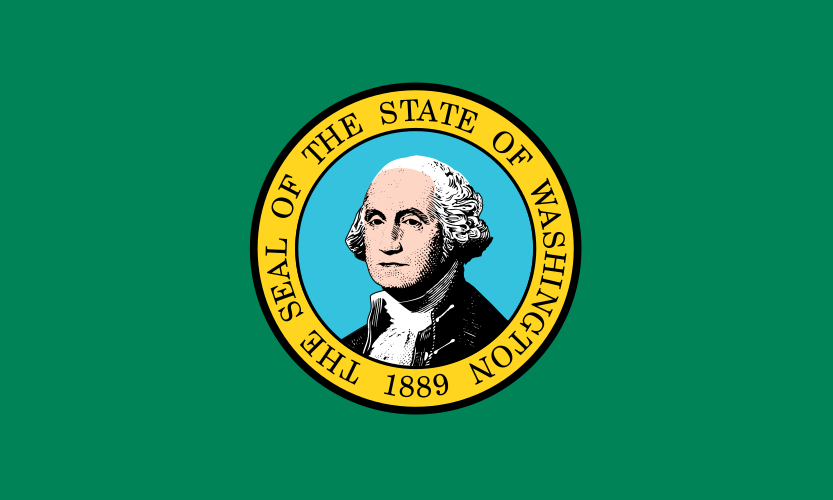
Washington
Capital
Olympia
State Bird

Willow Goldfinch
Statehood
November 11, 1889
State Flower

Coast Rhododendron
Population
7.9 million (2020)
Answer
Washington state experiences diverse weather patterns year-round due to its varied geography, including coastal areas, mountain ranges, and inland regions. The western part of the state, including cities like Seattle, has a temperate maritime climate characterized by mild, wet winters and cool, dry summers. This region receives significant rainfall mostly between October and April, while summers tend to be relatively clear and pleasant with moderate temperatures averaging in the 70s Fahrenheit. In contrast, eastern Washington, such as Spokane, experiences a more continental climate with colder winters, often dipping below freezing, and hotter, drier summers with temperatures frequently reaching the 80s or 90s Fahrenheit.
The Cascade Mountains create a rain shadow effect that results in eastern Washington being much drier than the west. Snowfall is common in the mountains during winter months, supporting winter sports and contributing to the state’s water supply. Coastal areas remain relatively mild throughout the year, rarely experiencing extreme temperature swings, while eastern Washington’s weather is more variable with colder winters and hotter summers. Overall, Washington’s weather is highly influenced by its topography, with significant differences between the wetter west and the drier east.
Key Points:
- Western Washington has mild, wet winters and dry, cool summers.
- Eastern Washington experiences colder winters and hotter, drier summers.
- The Cascade Mountains create a rain shadow, causing regional climate differences.
Washington’s weather varies greatly depending on location and season.
The Cascade Mountains create a rain shadow effect that results in eastern Washington being much drier than the west. Snowfall is common in the mountains during winter months, supporting winter sports and contributing to the state’s water supply. Coastal areas remain relatively mild throughout the year, rarely experiencing extreme temperature swings, while eastern Washington’s weather is more variable with colder winters and hotter summers. Overall, Washington’s weather is highly influenced by its topography, with significant differences between the wetter west and the drier east.
Key Points:
- Western Washington has mild, wet winters and dry, cool summers.
- Eastern Washington experiences colder winters and hotter, drier summers.
- The Cascade Mountains create a rain shadow, causing regional climate differences.
Washington’s weather varies greatly depending on location and season.
Ask another question
🌦 Weather in Olympia - June 24, 2026
🏙 Popular Cities in Washington
Advertisement
📰 News in Washington
- Watch: Why the Washington DC Reflecting Pool became a global talking point
- George Washington’s letter accepting British surrender in America goes on display in London
- Trump abruptly cancels signing of bipartisan bill on affordable housing
- Trump turns America 250 kickoff into a campaign-style rally on the National Mall
- Trump set to return to Washington Hilton for first time since correspondents dinner shooting
- Man arrested near Trump’s reflecting pool plans to fight obscenity charge
- Another Spirit of ’76: George Washington’s Whiskey
- Trae Young welcomes AJ Dybantsa to Washington D.C., hints at jersey number
- Trump’s DOJ withdrew subpoenas targeting Washington Post and WSJ reporters
- D.C.'s socialist era is coming
- Are ChatGPT and other AI chatbots politically biased? We tested them.
- Washington County Commissioners Primary Outcomes