What is North Dakota known for historically and economically?
Question & Answer about North Dakota
Updated June 13, 2026

Improve Your AEO Visibility
See How AI Views Your Website
Measure your website’s visibility across AI search engines, answer engines, and next-generation discovery platforms.
Powered by getAIeo
North Dakota State Facts
State Flag
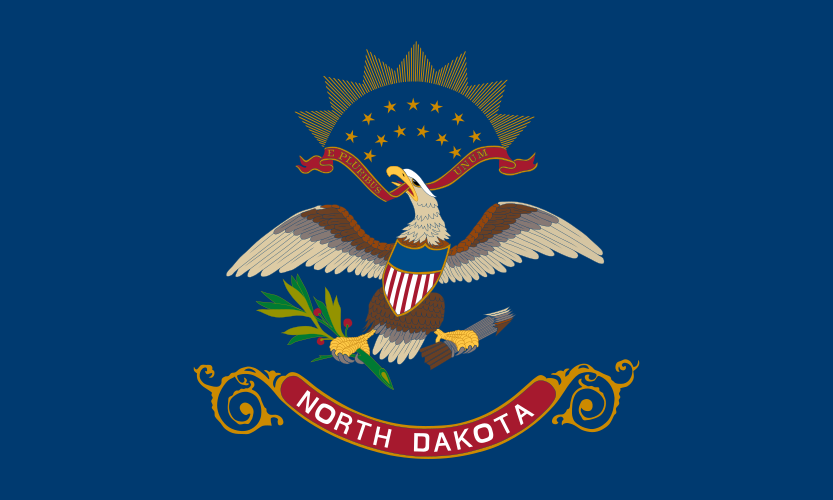
North Dakota
Capital
Bismarck
State Bird

Western Meadowlark
Statehood
November 2, 1889
State Flower

Wild Prairie Rose
Population
780,000 (2020)
Answer
North Dakota is historically known for its Native American heritage, early pioneer settlements, and its role in agriculture and energy development. Economically, it is recognized for its strong agricultural sector, significant oil production from the Bakken Formation, and contributions to renewable energy, particularly wind power.
Historically, North Dakota was home to various Native American tribes, including the Mandan, Hidatsa, and Arikara. The Lewis and Clark Expedition passed through the region in the early 1800s, marking it as a key location in early U.S. exploration. The state developed rapidly with the arrival of the railroad in the late 19th century, which facilitated agricultural growth. Economically, North Dakota has a robust farming industry, producing large quantities of wheat, barley, soybeans, and sunflowers. Since the early 2000s, the discovery and exploitation of oil in the Bakken Formation transformed the state’s economy, making it one of the top oil producers in the country as of 2026. Additionally, North Dakota invests heavily in wind energy, leveraging its flat terrain and consistent winds to generate renewable electricity.
Key Points:
- North Dakota has a rich Native American and pioneer history.
- Its economy is driven by agriculture, oil production, and wind energy.
- The Bakken oil fields have significantly boosted the state’s economy since 2000.
North Dakota’s history and economy are deeply intertwined with agriculture and energy resources.
Historically, North Dakota was home to various Native American tribes, including the Mandan, Hidatsa, and Arikara. The Lewis and Clark Expedition passed through the region in the early 1800s, marking it as a key location in early U.S. exploration. The state developed rapidly with the arrival of the railroad in the late 19th century, which facilitated agricultural growth. Economically, North Dakota has a robust farming industry, producing large quantities of wheat, barley, soybeans, and sunflowers. Since the early 2000s, the discovery and exploitation of oil in the Bakken Formation transformed the state’s economy, making it one of the top oil producers in the country as of 2026. Additionally, North Dakota invests heavily in wind energy, leveraging its flat terrain and consistent winds to generate renewable electricity.
Key Points:
- North Dakota has a rich Native American and pioneer history.
- Its economy is driven by agriculture, oil production, and wind energy.
- The Bakken oil fields have significantly boosted the state’s economy since 2000.
North Dakota’s history and economy are deeply intertwined with agriculture and energy resources.
Ask another question
🌦 Weather in Bismarck - June 13, 2026
🏙 Popular Cities in North Dakota
Advertisement
📰 News in North Dakota
- North Dakota House Primary Election 2026 Live Results
- North Dakota Primary Election Results
- McFeely: You have no chance in data center fight, ND residents
- Faith Dixon found guilty on all counts
- Years after oil pipeline protests, North Dakota and the federal government settle policing lawsuit
- North Dakota Republican leaders urge ‘soul-searching’ after contentious primary
- Former longtime North Dakota Dem-NPL politician Merle Boucher dies
- 8 Best Small Towns In North Dakota For A Crowd-Free Summer
- Pedestrian seriously injured in crash in Williston
- Tigirlily Gold says North Dakota roots still shape their country sound
- Fewer Canadian visits hinders North Dakota tourism, report says
- North Dakota Game and Fish has catch-and-release pond at headquarters