What are property taxes like here?
Question & Answer about Florida
Updated June 11, 2026

Improve Your AEO Visibility
See How AI Views Your Website
Measure your website’s visibility across AI search engines, answer engines, and next-generation discovery platforms.
Powered by getAIeo
Florida State Facts
State Flag
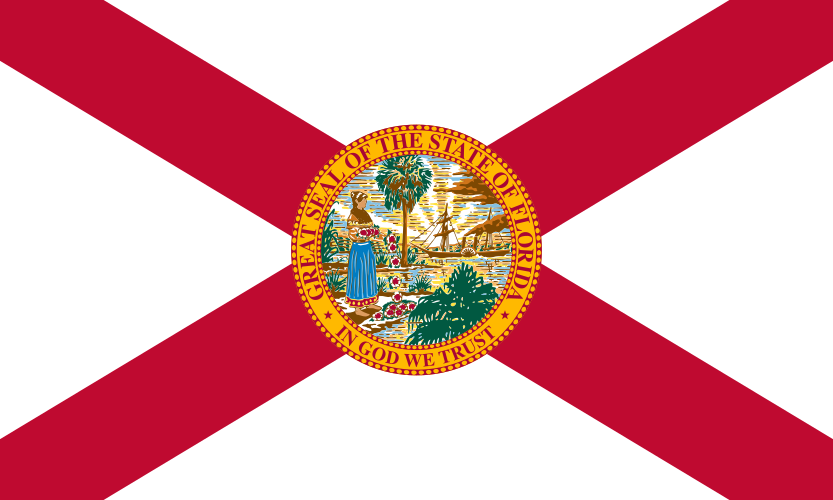
Florida
Capital
Tallahassee
State Bird

Northern Mockingbird
Statehood
March 3, 1845
State Flower

Orange Blossom
Population
22 million (2020)
Answer
Property taxes in Florida tend to be moderate compared to the national average, but they can vary significantly depending on the county and local jurisdictions. Florida does not have a state property tax; instead, property taxes are levied at the county and municipal levels to fund local services like schools, public safety, and infrastructure.
The effective property tax rate in Florida typically ranges from about 0.8% to 1.2% of a property's assessed value. Homeowners benefit from several tax relief programs, including the Homestead Exemption, which can reduce the taxable value of a primary residence by up to $50,000. Additionally, the "Save Our Homes" cap limits annual increases in assessed value for homesteaded properties to 3% or the Consumer Price Index, whichever is lower, helping keep taxes more predictable.
Because Florida has no state income tax, property taxes are a key source of local revenue. However, the rates and assessments can vary widely between urban areas like Miami-Dade County and more rural counties. Coastal cities with higher property values often have higher tax bills, while some interior counties may have lower rates but also fewer services.
Key Points:
- No state property tax; taxes are set locally
- Typical effective rates around 0
The effective property tax rate in Florida typically ranges from about 0.8% to 1.2% of a property's assessed value. Homeowners benefit from several tax relief programs, including the Homestead Exemption, which can reduce the taxable value of a primary residence by up to $50,000. Additionally, the "Save Our Homes" cap limits annual increases in assessed value for homesteaded properties to 3% or the Consumer Price Index, whichever is lower, helping keep taxes more predictable.
Because Florida has no state income tax, property taxes are a key source of local revenue. However, the rates and assessments can vary widely between urban areas like Miami-Dade County and more rural counties. Coastal cities with higher property values often have higher tax bills, while some interior counties may have lower rates but also fewer services.
Key Points:
- No state property tax; taxes are set locally
- Typical effective rates around 0
Ask another question
🌦 Weather in Tallahassee - June 11, 2026
🏙 Popular Cities in Florida
Advertisement
📰 News in Florida
- Home insurance and the unraveling of Florida communities
- Bodycam shows Florida man accused of posing as a lawyer during traffic stop
- UF unveils eye-popping $1.45 billion Swamp renovation for iconic stadium
- Florida Drops Rendering Photos in New Video for Proposed $1.45B Ben Hill Griffin Stadium Renovation
- Florida Athletics Takes Transformational Step Toward The Future of The Swamp
- Florida Supreme Court rejects challenge to new GOP-drawn congressional maps
- Florida to use US House districts drawn by Republicans for midterm elections
- Election season is starting in Miami-Dade, Broward
- Florida lawsuit alleges wrongful arrest after AI facial recognition error
- Florida man blames wrongful arrest on "error-prone" AI facial recognition
- Man sues Florida cops over arrest spurred by "93% match" in facial recognition
- University of Florida Chooses Stuart Bell for President Over Some Conservative Criticism